
Overview
Symantec Endpoint Security (SES) is Broadcom's endpoint protection product line. Broadcom bought Symantec's enterprise security business in November 2019, and the endpoint products are now sold under the Symantec brand by Broadcom and its partners.
SES comes in two subscriptions: Symantec Endpoint Security Enterprise (SESE) and Symantec Endpoint Security Complete (SESC). According to Broadcom's documentation, the policy types that require Complete are Application Control, Adaptive Protection, Detection and Response (EDR), Threat Defense for Active Directory and Trusted Updater. Licenses are counted per managed device: desktops, laptops, servers, thin clients, workstations, mobile devices and virtual environments with the agent installed.
Agents can be managed from the Integrated Cyber Defense Manager cloud console, from the on-premises Symantec Endpoint Protection Manager (SEPM), or in a hybrid setup where SEPM is enrolled in the cloud (version 14.3 RU1 or later). Broadcom notes that hybrid-managed SEPMs cannot use the Detection and Response policy.
Key Features
Adaptive Protection
Blocks unused and potentially dangerous application behaviors. Complete only; not supported on Mac or Linux devices.
Detection and Response
EDR policy for investigating and responding to threats on endpoints (Complete only).
Threat Defense for Active Directory
Protection against attacks that target Active Directory (Complete only).
Cloud, On-Prem or Hybrid
Manage agents from the cloud console, from Symantec Endpoint Protection Manager, or both.
Application Control
Policy-based control of which applications can run (Complete only).
Per-Device Licensing
Devices are counted against SESE or SESC depending on which policies are applied to them.
Pros & Cons
Advantages
- Choice of cloud, on-premises or hybrid management
- Complete bundles EDR, Active Directory defense and application control
- Existing SEPM deployments can be enrolled in the cloud console
- Clients can be moved between Enterprise and Complete device groups
Disadvantages
- No public price list; sold through Broadcom partners
- EDR, Adaptive Protection and application control require Complete
- Adaptive Protection is not supported on Mac or Linux
- Hybrid-managed SEPMs cannot use the Detection and Response policy
Pricing
Pricing is quote-based. Broadcom does not publish list prices; SES is sold as a per-device subscription through Broadcom and its partners.
SES Enterprise
Endpoint protection subscription. If it is your only subscription, every device with applied policies counts against it.
SES Complete
Adds Application Control, Adaptive Protection, Detection and Response, Threat Defense for Active Directory and Trusted Updater.
What sets the price
Number of managed devices, the subscription tier (Enterprise or Complete) and the term negotiated with the partner.
Best Use Cases
Ideal For:
- Existing Symantec Endpoint Protection customers moving to cloud or hybrid management
- Organizations that need to keep an on-premises management server
- Windows-heavy fleets that want Adaptive Protection and Active Directory defense
- Teams that want EPP and EDR from a single agent
May Not Be Ideal For:
- Buyers who want self-service online purchase with published prices
- Mac- and Linux-heavy fleets counting on Adaptive Protection
- Hybrid SEPM deployments that need the EDR policy
Comparison
Symantec Endpoint Security vs Competitors
- vs CrowdStrike Falcon: Falcon is managed only from CrowdStrike's cloud console; SES still offers an on-premises manager and a hybrid mode.
- vs Microsoft Defender for Endpoint: Defender is managed from the Microsoft Defender portal and is included in Microsoft 365 E5; SES is a separate per-device subscription.
- vs TrendAI Vision One: Trend sells its platform through a credit-based license; SES is split into two fixed subscriptions.
Screenshots & Interface
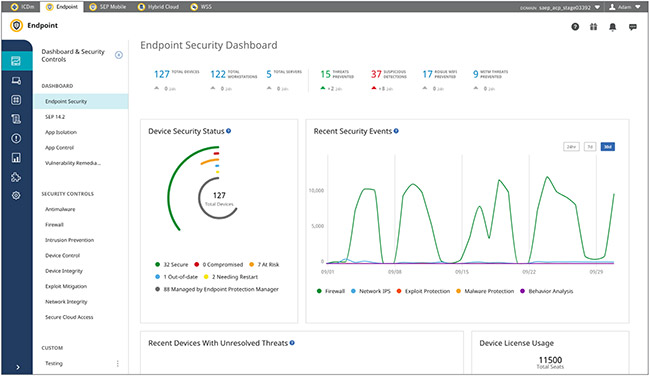
Explore Symantec Endpoint's interface:
Frequently Asked Questions
Who owns Symantec Endpoint Security?
Broadcom. It completed the acquisition of Symantec's enterprise security business on November 4, 2019.
What is the difference between SES Enterprise and SES Complete?
Complete adds the Application Control, Adaptive Protection, Detection and Response, Threat Defense for Active Directory and Trusted Updater policies.
Can it be managed on-premises?
Yes. Agents can be managed from Symantec Endpoint Protection Manager, from the cloud console, or in a hybrid setup with SEPM 14.3 RU1 or later.
Is pricing published?
No. SES is a per-device subscription quoted by Broadcom or its partners.
Which devices are covered?
Desktops, laptops, servers, thin clients, workstations, mobile devices and virtual environments with the agent installed. Adaptive Protection is not available on Mac or Linux.
Final Verdict
Symantec Endpoint Security stands out for letting agents be managed from an on-premises server, a cloud console or both. The most useful capabilities, including EDR and Active Directory defense, require the Complete subscription, and buying goes through Broadcom's partner channel with no public prices.