Ready to Get Started?
Explore ALEKS with a free trial for instructors or for independent learners.
Overview
ALEKS (Assessment and Learning in Knowledge Spaces) is an adaptive learning and assessment system owned by McGraw Hill. It covers math, chemistry, statistics and accounting, and McGraw Hill says it has been used by more than 50 million students.
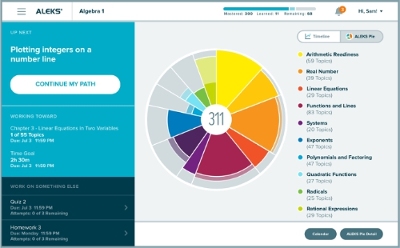
Instead of giving a numeric test score, ALEKS starts with an Initial Knowledge Check that maps which topics a student has mastered and which ones they are ready to learn. Students then work only on those ready-to-learn topics, and periodic knowledge checks confirm what they have retained.
ALEKS was first developed at UC Irvine from 1994 with National Science Foundation funding, and McGraw-Hill Education acquired ALEKS Corporation in 2013. It is sold to K-12 schools and colleges, and families can buy individual subscriptions directly.
Key Features
Initial Knowledge Check
A short adaptive assessment: each question is chosen from the previous answers to place the student precisely within the course.
Ready-to-Learn Topics
Students only see topics ALEKS judges they are ready for, and pick from interactive learning modules.
Knowledge Space Theory Engine
The model is based on Knowledge Space Theory and trained on data from millions of students, according to McGraw Hill.
Explanations and Feedback
Each problem comes with a complete explanation and immediate feedback.
Progress Monitoring
Instructors create assignments and track student and class progress; independent users get automated progress reports.
ALEKS PPL
A separate Placement, Preparation and Learning product that colleges use for math placement and course readiness.
Pros & Cons
Advantages
- Topic-level adaptive placement instead of a single score
- Covers K-12 and college courses in math, chemistry, statistics and accounting
- Published family pricing, starting at $19.95 per month
- Free trials for instructors and for independent users
- Dedicated placement product (ALEKS PPL) for colleges
Disadvantages
- Narrow subject range: no humanities or language courses
- Individual subscriptions allow only one course at a time
- School and college pricing is not published
- Help comes as explanations, not as a chat-style AI tutor
Pricing
McGraw Hill publishes prices for individual (family) subscriptions. School and college licenses are quote-based.
1 Month
$19.95
3 Months
$49.95
6 Months
$99.95
12 Months
$179.95
A subscription gives access to all courses, one course at a time, and includes a student account and a master account. You can switch courses during the subscription.
Best Use Cases
ALEKS Excels For:
- Colleges that need math placement and course readiness (ALEKS PPL)
- Math, chemistry and statistics courses that want mastery-based homework
- Families looking for self-paced practice, remediation or homeschooling in math or chemistry
- Students preparing for college-level math
May Not Be Ideal For:
- Subjects outside math, chemistry, statistics and accounting
- Learners who want a conversational AI tutor
- Families who need several courses at once on one subscription
Comparison
ALEKS vs Competitors
vs Knewton Alta
Wiley's adaptive, mastery-based courseware also targets college math, chemistry and statistics, and is sold per course to students (from $44.95 per term).
vs Carnegie Learning (MATHia)
MATHia focuses on grades 6-12 math with hints and real-time teacher alerts, and is sold only to schools. ALEKS also covers college courses and sells to families.
vs Khanmigo
Khan Academy's chat-based AI tutor covers many subjects for $4/month (U.S. only). ALEKS is narrower but built around formal knowledge assessment.
See more tools in our AI education category.
Screenshots & Interface
Explore Aleks's interface:
Frequently Asked Questions
What subjects does ALEKS cover?
Math, chemistry, statistics and accounting, from K-12 through college level.
How much does ALEKS cost for families?
Individual subscriptions cost $19.95 for 1 month, $49.95 for 3 months, $99.95 for 6 months or $179.95 for 12 months. School and college pricing comes from McGraw Hill sales.
Does ALEKS offer a free trial?
Yes. ALEKS lists free trials for instructors and administrators, and for families and individuals.
How does the ALEKS Knowledge Check work?
It asks a small number of adaptive questions, each chosen based on earlier answers, and determines which topics the student has mastered and which they are ready to learn.
Who owns ALEKS?
McGraw Hill. McGraw-Hill Education acquired ALEKS Corporation in 2013.
What is ALEKS PPL?
ALEKS Placement, Preparation and Learning: a McGraw Hill product that colleges and universities use for math placement and course preparedness.
Final Verdict
ALEKS is a mature, assessment-first system for math, chemistry, statistics and accounting, and its topic-level placement is its main strength. It fits courses and families focused on those subjects, less so anyone looking for a broad, conversational AI tutor.