
Overview
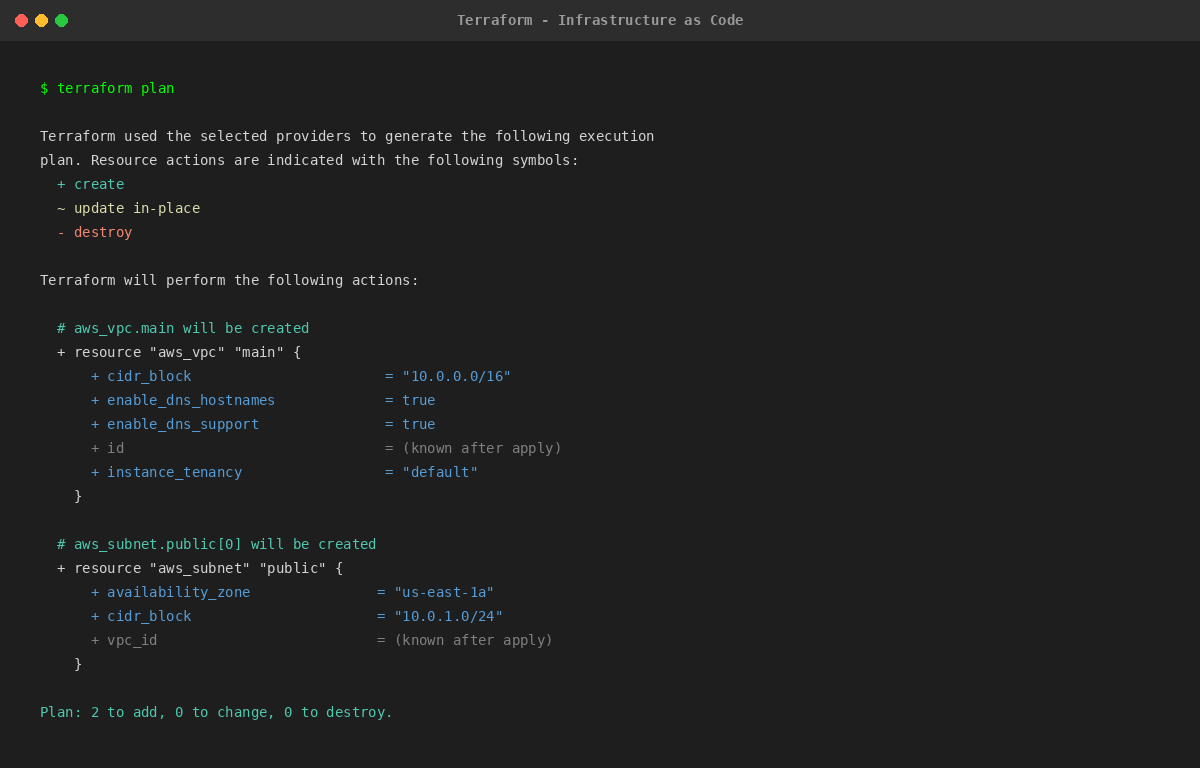
Terraform is HashiCorp's infrastructure-as-code tool. You describe infrastructure in HashiCorp Configuration Language (HCL), run terraform plan to preview the changes, then terraform apply to create, update or destroy resources. Providers translate the configuration into API calls for cloud platforms, SaaS products, Kubernetes and network devices.
Terraform records what it manages in a state file, which is how it computes the difference between your code and the real infrastructure. The public Terraform Registry hosts providers and reusable modules; HashiCorp announced that the registry had passed 3,000 providers.
The Terraform CLI is free to download. In August 2023 HashiCorp moved future releases from the Mozilla Public License 2.0 to the Business Source License 1.1, which allows all uses except offering a product that competes with HashiCorp. The community fork OpenTofu, run under the Linux Foundation, was created in response.
The commercial editions are HCP Terraform (formerly Terraform Cloud), a managed service billed per managed resource, and Terraform Enterprise, the self-managed edition with custom pricing. IBM has owned HashiCorp since February 2025.
Key Features
HCL and Plan/Apply
Declarative configuration in HCL; terraform plan shows every change before terraform apply runs it.
State Management
A state file maps configuration to real resources; HCP Terraform stores state remotely with locking and version history.
Providers and Registry
Providers for AWS, Azure, Google Cloud, Kubernetes and many other services, plus shared modules in the public Terraform Registry.
Policy as Code
Sentinel and OPA policies checked during HCP Terraform runs, available from the free tier.
Health Assessments
Drift detection and continuous validation of checks and conditions, in HCP Terraform Standard and Premium.
Private Registry and No-Code
A private module registry on every HCP Terraform tier; no-code provisioning from modules on Standard and above.
Pros & Cons
Advantages
- One plan/apply workflow across clouds, SaaS and network devices
- Plan output shows exactly what will change before it happens
- Free CLI and a large public registry of providers and modules
- HCP Terraform free tier: 500 managed resources, unlimited users
- SSO and Sentinel/OPA policies included even in the free tier
Disadvantages
- No longer open source: Business Source License 1.1 since August 2023
- State files must be stored and protected carefully, as they can contain sensitive values
- Drift detection requires HCP Terraform Standard or Premium
- Per-resource billing grows with the size of your infrastructure
- Terraform Enterprise pricing is not published
- HCL has fewer programming constructs than a general-purpose language
Pricing
The CLI is free. HCP Terraform is billed per managed resource, with a free tier:
Terraform CLI (free)
Download and run locally or in your own CI, under the Business Source License 1.1.
HCP Terraform Free ($0)
Up to 500 managed resources with unlimited users, SSO, Sentinel and OPA policies, run tasks and agents.
Essentials (from $0.10/resource/month)
Billed hourly ($0.00013 per resource per hour). Includes the private registry.
Standard (from $0.47/resource/month)
Adds health assessments (drift detection), no-code provisioning and HCP Waypoint.
Premium (from $0.99/resource/month)
Everything in Standard plus module revocation in the private registry.
Terraform Enterprise (custom)
Self-managed edition with premium support; quote from IBM sales. HCP Terraform Europe is also custom-priced.
Prices are in USD for business customers and exclude taxes. New HCP organizations receive a $500 trial credit. The legacy user-based free plan ended on March 31, 2026; remaining organizations were moved to the 500-resource free tier.
Best Use Cases
Ideal For:
- Platform teams standardizing provisioning across AWS, Azure and Google Cloud
- Teams that review infrastructure changes as code before applying them
- Organizations that need policy guardrails on every change (Sentinel or OPA)
- Network and security engineers automating vendors that publish Terraform providers
- Small projects that fit within 500 managed resources on HCP Terraform Free
May Not Be Ideal For:
- Organizations that require an open-source license (OpenTofu covers that case)
- Very large estates where per-resource HCP billing becomes expensive
- Teams that prefer writing infrastructure in a general-purpose language
Comparison
Terraform vs Alternatives
- vs OpenTofu: a community fork of Terraform under the Linux Foundation, presented as a drop-in replacement and created in response to the BSL change. It has no equivalent of HCP Terraform from HashiCorp.
- vs Pulumi: Pulumi uses general-purpose languages such as TypeScript, Python and Go instead of HCL.
- vs AWS CloudFormation: CloudFormation is AWS-native and AWS-only; Terraform uses one workflow across many providers.
Screenshots & Interface
Terraform's infrastructure-as-code workflow:
Frequently Asked Questions
Is Terraform still free?
The Terraform CLI is free to download and use under the Business Source License 1.1. HCP Terraform is free for up to 500 managed resources with unlimited users.
What is HCP Terraform?
HashiCorp's managed service for running Terraform, formerly called Terraform Cloud. It adds remote state, team workflows, policy checks, a private registry and, on Standard and Premium, health assessments.
How is HCP Terraform priced?
Per managed resource per month: from $0.10 on Essentials, $0.47 on Standard and $0.99 on Premium, billed hourly. Terraform Enterprise (self-managed) is custom-priced.
What changed with the Terraform license?
In August 2023 HashiCorp moved future releases from the MPL 2.0 to the Business Source License 1.1, which allows all uses except offering a competing product. OpenTofu is the open-source fork that followed.
Who owns Terraform now?
IBM. It completed its acquisition of HashiCorp on February 27, 2025.
Recommended Certifications
To demonstrate proficiency in infrastructure-as-code and cloud automation with Terraform, consider these HashiCorp certifications. They validate your ability to provision and manage infrastructure efficiently.
Terraform Associate
Foundational knowledge of Terraform concepts, workflows, and multi-cloud infrastructure provisioning.
Terraform Infrastructure Engineer Professional
HashiCorp's professional-level Terraform certification, for practitioners who already work with Terraform in production.
Final Verdict
Terraform's plan/apply workflow and provider registry make it a sound default for infrastructure as code across clouds and network vendors. The 2023 move to the Business Source License and IBM ownership matter mostly to teams that need an open-source license, and OpenTofu covers that case. HCP Terraform's free tier suits small estates; larger ones pay per managed resource.