Ready to Get Started?
Explore D-Wave's annealing quantum computers and hybrid solvers in the cloud.
Overview
Leap is D-Wave's cloud service for its annealing quantum computers. Instead of running gate-based circuits, you send optimization problems to Advantage and Advantage2 systems or to hybrid quantum-classical solvers. D-Wave lists the Advantage2 QPU at more than 4,400 qubits and 40,000 couplers.
The hybrid solvers are built for industry-scale problems; D-Wave says they handle up to two million variables and constraints. Typical uses on the official page are workforce and production scheduling, vehicle routing, resource optimization and cargo loading.
Developers work in Python with Ocean, D-Wave's open-source SDK. D-Wave advertises subsecond QPU response times with no queues or reservations, SOC 2 Type 2 compliance and 99.9% uptime.
Key Features
Advantage and Advantage2 QPUs
Annealing quantum computers; the Advantage2 QPU has more than 4,400 qubits and 40,000 couplers.
Hybrid solvers
Quantum-classical solvers for problems D-Wave says can reach two million variables and constraints.
Ocean SDK
Open-source Python tools for building quantum applications, usable in Codespaces and devcontainer-compatible IDEs.
Developer resources
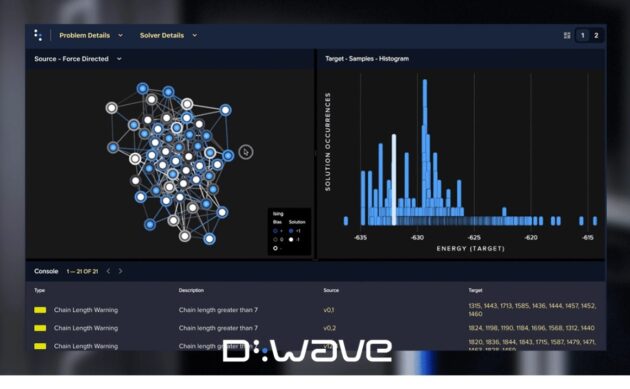
Documentation, GitHub code examples, demos, a visual problem inspector, training and community forums.
Regional solvers
Solvers in North America (West and East) and Europe; availability varies by region.
D-Wave Launch
Professional services program that onboards businesses.
Pros & Cons
Advantages
- Purpose-built for optimization problems such as scheduling and routing
- Hybrid solvers handle very large problems
- Open-source Ocean SDK in Python
- Vendor claims subsecond QPU responses without queues or reservations
- SOC 2 Type 2 compliance stated by D-Wave
- Free demos and training to get started
Disadvantages
- No public price list; plans are set by contract
- Annealing only: not for general gate-based quantum circuits
- Trial accounts can only run certain demos, with no API token
- Problems must be expressed as optimization models
- Problem history keeps only your 1,000 most recent problems, for up to 365 days
Pricing
D-Wave does not publish Leap prices on its website:
Trial
Sign up to access Leap demos. Trial Plan projects have no API token and can only run certain demos, not your own problems.
Paid plans
Pricing is quote-based; contact sales. Solver access depends on your plan, seat type and contract, and access time renews monthly.
Ocean SDK
The SDK is open source and free to install.
Details from D-Wave's Leap product page and Leap documentation, October 2026.
Best Use Cases
D-Wave Leap Excels For:
- Workforce and production scheduling
- Vehicle and logistics routing
- Resource allocation and cargo loading problems
- Teams exploring quantum optimization with professional onboarding (D-Wave Launch)
May Not Be Ideal For:
- Gate-model algorithm research (Shor, Grover, variational circuits)
- Users who want transparent self-serve pricing
- Problems that do not map to an optimization model
Comparison
D-Wave Leap vs Competitors
Where D-Wave Leap stands out
- Annealing hardware with thousands of qubits, aimed at optimization
- Hybrid solvers sized for industry problems
- No queues or reservations, according to D-Wave
Where alternatives fit better
- IBM Quantum: gate-based 100+ qubit processors with 10 free minutes per month
- Amazon Braket: gate-based and neutral-atom devices with published per-shot prices
- Azure Quantum: gate-based hardware from IonQ, Quantinuum, Pasqal and Rigetti
Screenshots & Interface
Explore D Wave Leap's interface:
Frequently Asked Questions
What is D-Wave Leap?
D-Wave's cloud service giving real-time access to its Advantage and Advantage2 annealing quantum computers and to hybrid quantum-classical solvers.
Is there a free trial?
Yes. You can sign up to access Leap demos. Trial Plan projects cannot submit your own problems and have no API token.
How much does Leap cost?
D-Wave does not publish prices. Pricing is quote-based; contact D-Wave sales.
What kinds of problems does it solve?
Optimization problems, such as scheduling, routing, resource optimization and cargo loading. It is not a general gate-based quantum computer.
How do I program it?
With Ocean, D-Wave's open-source Python SDK. You authorize Ocean with your Leap API token.
Is Leap secure?
D-Wave states that the service is SOC 2 Type 2 compliant and claims 99.9% uptime.
Final Verdict
D-Wave Leap is the main cloud option for quantum annealing and is designed around real optimization problems, with hybrid solvers that scale far beyond the QPU alone. It is not a gate-model platform, and pricing requires a sales conversation.