
Ready to Get Started?
Sign up for free IonQ Quantum Cloud simulator access.
Overview
IonQ builds trapped-ion quantum computers. Its current systems are Aria, Forte, Forte Enterprise and Tempo. Forte has 36 qubits, with published error rates of 0.02% for one-qubit gates and 0.4% for two-qubit gates; Forte Enterprise is a 36-qubit, rack-mountable system for on-premises use.
Access goes through IonQ Quantum Cloud, which offers a Cloud Console, noisy and ideal simulators, on-demand QPU access and reserved time, and through partner clouds Amazon Braket, Microsoft Azure and Google Cloud. IonQ supports Qiskit, Cirq, CUDA-Q, tket, Q#, PennyLane, ProjectQ and other SDKs.
Simulator access is free. Direct QPU access uses volume-based or custom pricing, while partner clouds publish their own rates. Academic researchers can apply for up to $10,000 in research credits.
Key Features
IonQ Quantum Cloud
Cloud Console to submit and track jobs, with organization management for enterprise teams.
Simulators
Ideal and noisy simulators for every stage of algorithm development, free to start.
Forte systems
36-qubit trapped-ion systems; Forte lists 0.02% one-qubit and 0.4% two-qubit gate error.
Multi-cloud access
IonQ hardware is also available through Amazon Braket, Microsoft Azure and Google Cloud.
Broad SDK support
Qiskit, Cirq, CUDA-Q, tket, Q#, PennyLane, ProjectQ and more; IonQ's compiler maps standard gates to native ones.
Reserved and on-prem options
Reserved QPU time for scheduled workloads, and Forte Enterprise for on-premises deployment.
Pros & Cons
Advantages
- Available on all three major clouds as well as IonQ's own
- Free simulator access to start
- Works with most popular quantum SDKs
- Published gate error rates for Forte
- Research credits of up to $10,000 for academics
- On-premises option with Forte Enterprise
Disadvantages
- Direct QPU pricing is not published (volume-based or custom)
- Expensive per run on partner clouds: $0.08 per shot on Braket, $168.195 minimum per program on Azure Forte with error mitigation
- On Braket, error mitigation requires at least 2,500 shots per task
- The free tier covers simulators, not QPU time
- 36 qubits on Forte, fewer than some superconducting systems with 100+ qubits
Pricing
IonQ pricing depends on how you access its systems:
IonQ Quantum Cloud
Free Access tier for simulators. QPU access uses volume-based pricing, with custom pricing on request: contact sales.
Amazon Braket
IonQ Forte: $0.30 per task plus $0.08 per shot. Braket Direct reservation: $7,000 per hour.
Azure Quantum
Per gate-shot pricing; minimum per program $97.50 on Aria 1 and $168.195 on Forte with error mitigation. Aria-Forte subscription: $25,000/month.
Research Credits
Academic researchers may qualify for up to $10,000 in funding.
Prices from IonQ's Quantum Cloud page, the Amazon Braket pricing page and Microsoft Learn's Azure Quantum pricing page, October 2026.
Best Use Cases
IonQ Excels For:
- Algorithms that benefit from full qubit connectivity
- Teams that want the same hardware across AWS, Azure and Google Cloud
- Academic research funded by IonQ research credits
- Organizations evaluating an on-premises quantum system
May Not Be Ideal For:
- Budget-limited projects that need many shots
- Users who want free QPU time (IBM's Open Plan offers it)
- Experiments that need more than 36 qubits
Comparison
IonQ vs Competitors
Where IonQ stands out
- Trapped-ion hardware on every major cloud
- Published low gate error rates on Forte
- Cloud, reserved and on-premises options from one vendor
Where alternatives fit better
- Quantinuum (via Azure Quantum): trapped-ion H2 systems, subscriptions from $125,000/month
- IBM Quantum: 100+ qubit superconducting processors with 10 free minutes per month
- Rigetti: superconducting hardware at $0.000425 per shot on Braket
Screenshots & Interface
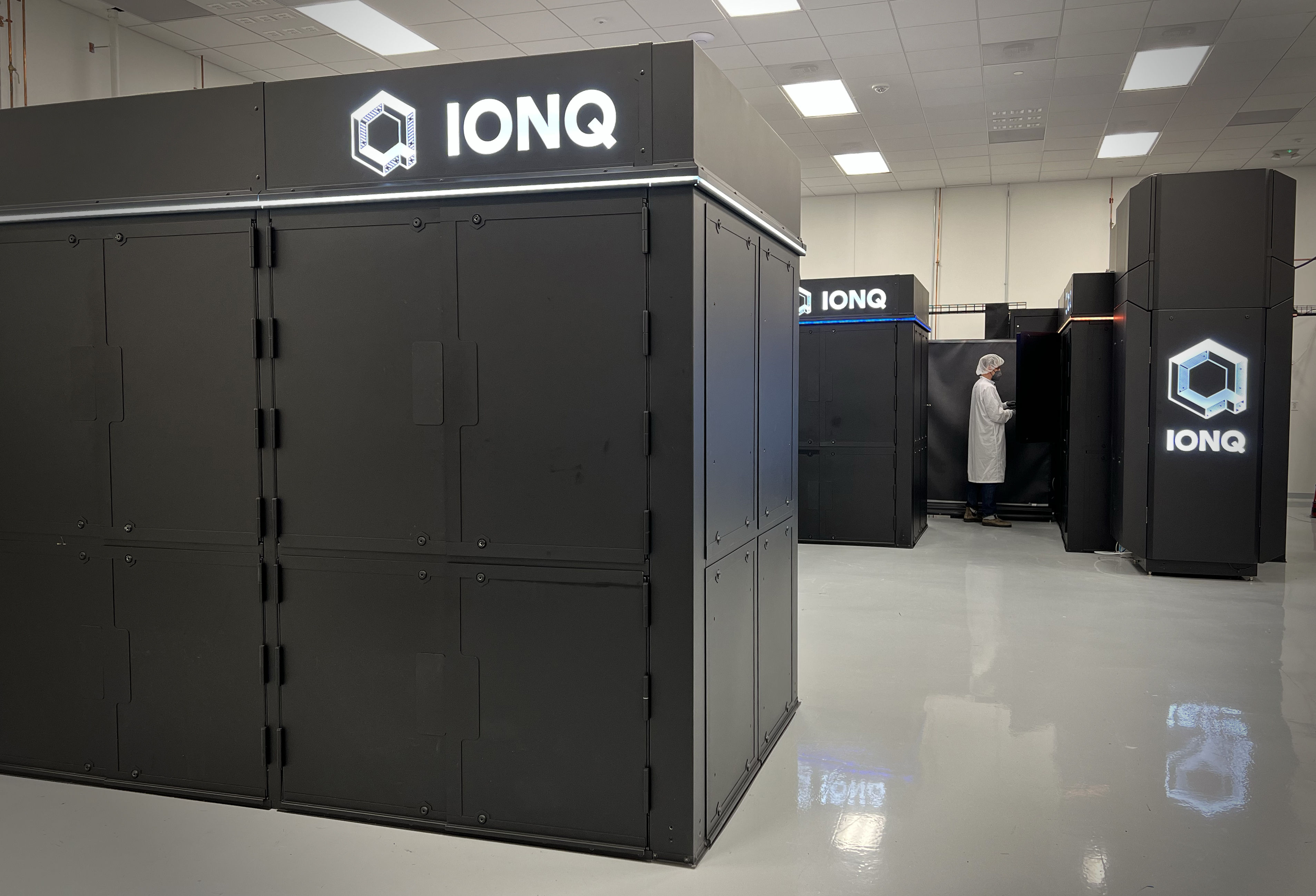
Explore Ionq's interface:
Frequently Asked Questions
How can I access IonQ quantum computers?
Through IonQ Quantum Cloud, or through Amazon Braket, Microsoft Azure and Google Cloud.
Is there free access?
Yes, for simulators: the Free Access tier lets you sign up and explore with IonQ's simulators. QPU access is a separate tier.
How much does IonQ cost?
Direct QPU access is volume-based or custom-priced. On Amazon Braket, Forte costs $0.30 per task plus $0.08 per shot; on Azure, pricing is per gate-shot with per-program minimums.
How many qubits do IonQ systems have?
Forte and Forte Enterprise have 36 qubits. IonQ also lists Aria and Tempo.
Which SDKs work with IonQ?
Qiskit, Cirq, CUDA-Q, tket, Q#, PennyLane, ProjectQ, TensorFlow and others, plus Braket compatibility.
Does IonQ offer research credits?
Yes. Academic researchers may qualify for up to $10,000 through the Research Credits Program.
Final Verdict
IonQ offers some of the most accessible trapped-ion hardware, available on every major cloud with broad SDK support and free simulators. QPU time is costly and direct pricing is custom, so plan shot counts carefully.