
Ready to Get Started?
Install PennyLane with pip and train quantum circuits like neural networks.
Overview
PennyLane is an open-source Python library for quantum computing, quantum machine learning and quantum chemistry, released under the Apache 2.0 license. It comes from Xanadu, a Toronto quantum computing company founded in 2016. Its stated goal is to train a quantum computer the same way as a neural network.
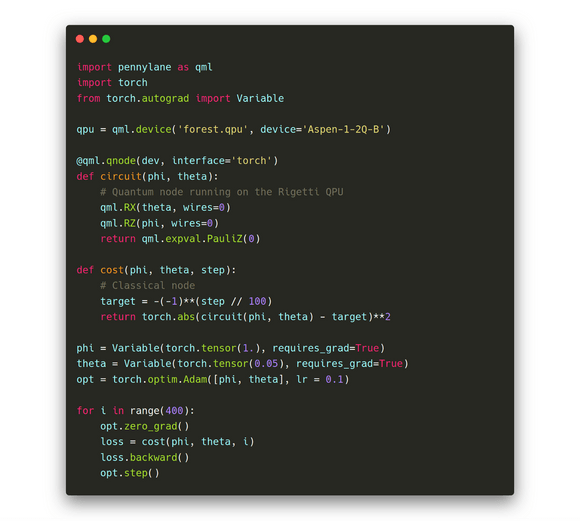
Quantum circuits in PennyLane can be differentiated automatically, so hybrid quantum-classical models can be trained with gradient-based methods and connected to PyTorch, JAX or NumPy. The Catalyst compiler adds just-in-time compilation of whole hybrid workflows.
The same code runs on many backends through plugins, including Amazon Braket, IBM (via PennyLane-Qiskit), Google Cirq, Rigetti, Microsoft QDK and Strawberry Fields. High-performance Lightning simulators run on GPUs, supercomputers and the cloud.
Key Features
Automatic differentiation
Quantum circuits are differentiable, enabling gradient-based training of hybrid models.
ML framework integration
Connect quantum circuits to PyTorch, JAX and NumPy.
Catalyst compiler
Just-in-time compilation of hybrid workflows, including adaptive circuits and real-time measurement feedback.
Lightning simulators
High-performance simulators that run on GPUs, supercomputers and the cloud.
Device plugins
Run on Amazon Braket, IBM, Google Cirq, Rigetti, Microsoft QDK, Strawberry Fields and more.
Demos and resource estimation
Research demos and tutorials for chemistry, optimization and QML, plus resource estimation tools.
Pros & Cons
Advantages
- Free and open source under Apache 2.0
- Automatic differentiation built in, ideal for quantum machine learning
- Hardware-agnostic: one codebase for many backends
- Integrates with PyTorch and JAX
- Large library of demos and an active community forum
Disadvantages
- Not a hardware service; running on QPUs requires a provider account and its fees
- Requires Python 3.12 or later
- Hardware access depends on separate plugins with their own setup
- Its machine-learning focus adds concepts beyond plain circuit programming
Pricing
PennyLane itself is free:
PennyLane library
Free and open source (Apache 2.0). Install with python -m pip install pennylane.
Hardware runs
Billed by the backend provider you choose, such as Amazon Braket or IBM Quantum.
Details from the PennyLane documentation (release 0.45.1) and GitHub repository, October 2026.
Best Use Cases
Xanadu PennyLane Excels For:
- Quantum machine learning and variational algorithms
- Quantum chemistry simulations
- Researchers who want to test the same code on several hardware backends
- GPU-accelerated simulation with Lightning
May Not Be Ideal For:
- Users looking for a managed cloud with hardware included
- Projects locked to Python versions older than 3.12
- Teams targeting a single vendor that prefer its native SDK
Comparison
Xanadu PennyLane vs Competitors
Where PennyLane stands out
- Automatic differentiation and ML framework integration as core features
- Hardware-agnostic plugins across many vendors
- Catalyst JIT compilation of hybrid workflows
Where alternatives fit better
- Google Cirq: lower-level, device-aware circuit programming for NISQ research
- IBM Quantum (Qiskit): SDK tied to IBM hardware with 10 free minutes per month
- Amazon Braket: managed service with hardware from several vendors
Screenshots & Interface
Explore Xanadu Pennylane's interface:
Frequently Asked Questions
Is PennyLane free?
Yes. PennyLane is open source under the Apache License 2.0.
Who makes PennyLane?
PennyLane is developed by Xanadu, a quantum computing company based in Toronto, together with open-source contributors.
Which hardware can I use?
Through plugins: Amazon Braket, IBM (PennyLane-Qiskit), Google Cirq, Rigetti, Microsoft QDK, Strawberry Fields, ProjectQ and others. Hardware fees are charged by the provider.
Does it work with PyTorch or JAX?
Yes. PennyLane connects quantum circuits to PyTorch, JAX and NumPy, with automatic differentiation.
What is Catalyst?
PennyLane's just-in-time compiler for entire hybrid quantum-classical workflows.
How do I install it?
Run python -m pip install pennylane. Python 3.12 or later is required.
Final Verdict
PennyLane is the go-to free library for quantum machine learning and differentiable quantum programming, and it runs the same code across many backends. It is software only, so real hardware runs depend on a separate provider.