
Ready to Get Started?
Enter one paper and get a graph of the research most similar to it.
Overview
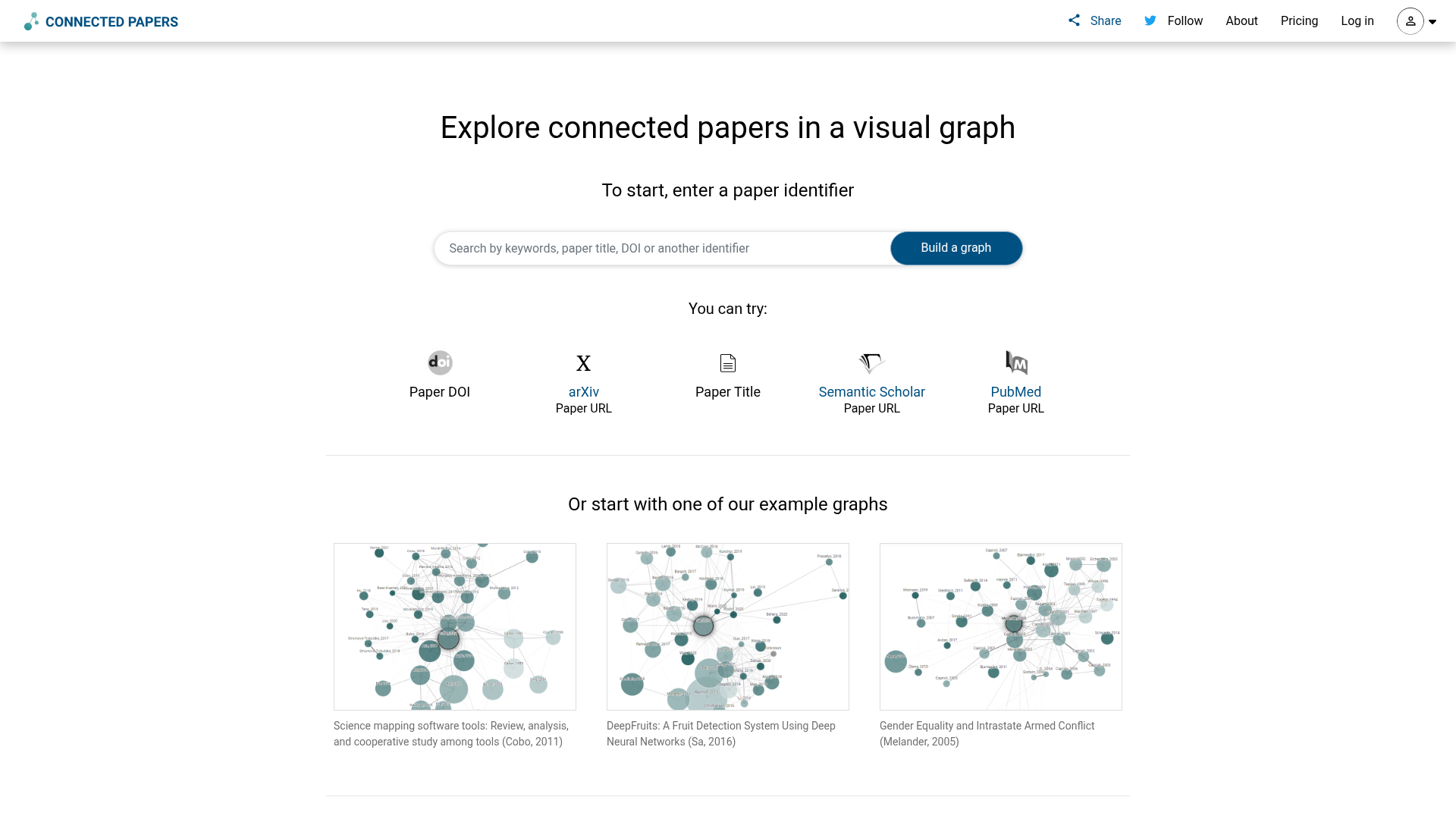
Connected Papers is a visual discovery tool for academic literature. You start from one paper and it builds a graph of related papers around it. Each node is a paper; similar papers cluster together and are joined by stronger lines.
The graph is not a citation tree. Similarity is based on co-citation and bibliographic coupling: two papers with heavily overlapping citations and references are treated as related, even if they never cite each other. A force-directed layout then places them on the map. Paper metadata comes from the Semantic Scholar corpus, which covers hundreds of millions of papers across all fields.
The project started as a weekend side project between friends and is still run by a small independent team. It is most useful when you enter a new field and want a fast picture of the work closest to a paper you already know.
Key Features
Similarity graphs
One origin paper produces a map of related work, arranged by similarity rather than by direct citations.
Prior works
Lists the papers most often cited by the papers in the graph, which usually surfaces foundational work.
Derivative works
Lists papers that cite many papers in the graph, a quick way to find recent surveys and follow-up work.
Multi-origin graphs
Build a single graph from several origin papers to map a topic rather than one article.
Saved papers and graph history
Keep papers you want to return to and reopen graphs you built earlier; graph history can be exported as a .bib file.
Group accounts
Administrators buy seats and assign premium access to lab or company members on a single invoice.
Pros & Cons
Advantages
- The free tier includes every feature, limited only by the number of graphs
- Finds closely related papers that do not cite each other
- Prior and derivative works views make it easy to find foundations and follow-ups
- Covers all fields through the Semantic Scholar corpus
- Nothing to set up: one paper is enough to start
Disadvantages
- Free accounts are limited to 5 graphs per month
- Papers with too few citations and references cannot produce a graph
- No AI summaries, question answering or data extraction
- No new-paper alerts in the published feature list
- Coverage and metadata depend entirely on Semantic Scholar
Pricing
Connected Papers has a free tier and two paid plans that remove the monthly graph limit.
Free
5 graphs per month with all features included.
Academic
Unlimited graphs. For academic institutions, non-profits and personal use; available as individual or group plans.
Business
Unlimited graphs. For use in a commercial or for-profit context; available as individual or group plans.
Paid-plan prices are shown on the official pricing page and in your local currency, so we do not quote a figure here. Group seats can be added mid-cycle at a prorated cost.
Best Use Cases
Connected Papers Excels For:
- Students and researchers starting a literature review in an unfamiliar field
- Finding the foundational papers behind a topic (prior works)
- Finding recent surveys and follow-up studies (derivative works)
- Checking for closely related papers you may have missed before submitting
May Not Be Ideal For:
- Summarising papers or extracting data from them
- Very recent papers that have few citations and references yet
- Ongoing monitoring of new publications on a topic
Comparison
Connected Papers vs Competitors
vs Litmaps
Litmaps also maps literature from seed articles but adds new-paper alerts; its Pro plan is $10/month.
vs ResearchRabbit
ResearchRabbit's free plan offers unlimited searching with up to 50 seed articles, plus collections you can share.
vs Semantic Scholar
Same underlying data, but Semantic Scholar is a free search engine with TLDR summaries and alerts rather than a similarity graph.
See all tools in this category on our research tools page.
Screenshots & Interface
Explore Connected Papers's interface:
Frequently Asked Questions
Is Connected Papers free?
Yes. The free tier includes all features and 5 graphs per month. The Academic and Business plans give unlimited graphs.
How does Connected Papers decide that two papers are related?
It measures similarity with co-citation and bibliographic coupling: papers with overlapping citations and references are considered related, even without a direct citation between them.
Where does the data come from?
Paper metadata comes from the Semantic Scholar paper corpus.
What are prior and derivative works?
Prior works are papers frequently cited by the graph's papers, often the field's foundations. Derivative works are papers that cite many graph papers, often recent reviews.
What is the difference between the Academic and Business plans?
Both remove the free-plan limits. Academic is for academic, non-profit and personal use; Business is for commercial use.
Final Verdict
Connected Papers does one job well: it turns a single paper into a map of its closest neighbours, including papers that never cite each other. The free tier covers occasional use, and heavy users can pay for unlimited graphs. Pair it with a reading or summarising tool, because it does not analyse paper content.