Ready to Get Started?
Ask a research question and get answers drawn from peer-reviewed papers.
Overview
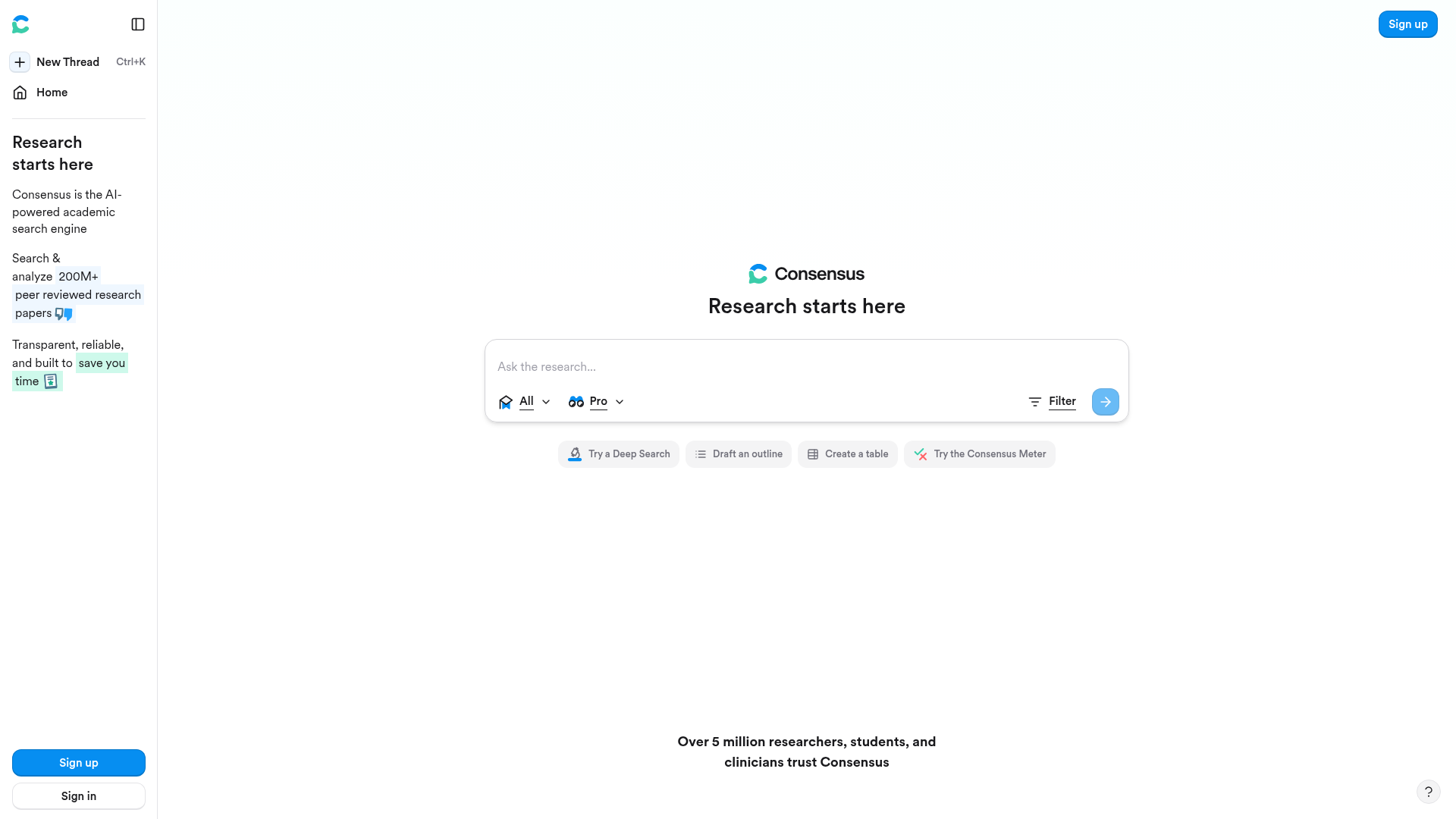
Consensus is an AI search engine for academic research. It describes itself as a research OS for finding, organizing and analyzing science, and it searches more than 400 million scientific papers.
You ask a question and get a synthesized answer with citations. For yes/no questions, the Consensus Meter shows how much of the literature agrees. Study Snapshots summarise each paper's key findings and methodology. Pro Search analyses up to 20 papers using full texts and abstracts, and Deep Search writes a literature review of up to 50 papers.
It is aimed at students, researchers and clinicians. You can import your Zotero library, export citations, and connect Consensus to AI tools such as Claude and ChatGPT so they can search its corpus.
Key Features
Consensus Meter
Shows the level of scientific agreement on a yes/no question.
Pro Search
Synthesized answers from a dynamic analysis of up to 20 papers, using full texts and abstracts.
Deep Search
A literature review of up to 50 papers; paid plans include a monthly number of Deep Searches.
Study Snapshots
Summaries of a paper's key findings and methodology.
Ask Paper
Chat with a paper. Works on open-access papers with a full-text PDF, or on a PDF you upload.
Zotero, exports and AI connectors
Import a Zotero library, export citations as RIS, BibTeX or CSV, and connect Claude, ChatGPT and other tools to the corpus.
Pros & Cons
Advantages
- Answers are built from academic papers and linked to their sources
- The Consensus Meter gives a quick read on where evidence stands
- Large corpus of 400M+ papers
- Zotero import and RIS, BibTeX and CSV export
- Free plan, plus up to 40% off for students, faculty and US clinicians
Disadvantages
- Ask Paper only works on open-access full texts unless you upload the PDF
- Deep Searches are capped per month, depending on the plan
- The Consensus Meter only applies to yes/no questions
- The site does not name its data sources or list security certifications
- Support and interface are English-only
Pricing
Consensus offers a free plan and paid individual and team plans.
Free
Free access to Consensus search, with limited use of the advanced modes.
Pro
Unlimited Pro Search and more analysis features for individuals.
Deep
Adds a larger monthly allowance of Deep Searches, for frequent literature reviews.
Teams and Enterprise
Pro for teams of 2 to 200 seats; larger organizations and universities contact sales.
Current prices load dynamically on the official pricing page (monthly or annual billing). Students and faculty with a school email, and US healthcare professionals with an NPI number, can get up to 40% off.
Best Use Cases
Consensus Excels For:
- Checking what the research says about a specific question
- Students writing essays and theses who need peer-reviewed sources
- Clinicians looking for study-level evidence quickly
- Researchers who want to plug a paper corpus into Claude or ChatGPT
May Not Be Ideal For:
- Formal systematic reviews with screening and extraction protocols
- Questions that depend on non-academic sources such as news or company data
- Reading paywalled papers without your own PDF
Comparison
Consensus vs Competitors
vs Elicit
Elicit focuses on systematic reviews, screening and data-extraction tables; its Pro plan costs $49 per user per month.
vs scite
scite classifies citations as supporting or contrasting a claim; its Basic plan is $12/month billed yearly, with no free plan.
vs Perplexity Deep Research
Perplexity searches the open web, not only papers, and turns the results into a cited report.
See all tools in this category on our research tools page.
Screenshots & Interface
Explore Consensus's interface:
Frequently Asked Questions
Is Consensus free?
Yes, there is a free plan. Paid Pro and Deep plans add unlimited Pro Search and more Deep Searches.
What is the Consensus Meter?
It shows how much of the scientific literature agrees on the answer to a yes/no question.
How many papers does Consensus search?
Consensus says it searches more than 400 million scientific papers.
Is there a student discount?
Yes. Students and faculty with a valid school email, and US healthcare professionals with an NPI number, can get up to 40% off.
Does Consensus work with Zotero?
Yes. You can import your Zotero library, and citations export in RIS, BibTeX and CSV.
Final Verdict
Consensus is one of the quickest ways to see what peer-reviewed research says about a question, and the Consensus Meter makes the state of evidence easy to read. The free plan is enough to try it; frequent users will want Pro or Deep. For formal systematic reviews, a dedicated tool like Elicit fits better.