
Ready to Get Started?
Search more than 200 million papers for free, with AI summaries and alerts.
Overview
Semantic Scholar is a free, AI-powered research tool for scientific literature, based at Ai2 (the Allen Institute for AI). It launched in November 2015 and indexes more than 214 million papers from all fields of science.
Search results include TLDRs, AI-generated one-sentence summaries of a paper's objective and results, and Highly Influential Citations, flagged by a model that judges which citations had a significant impact. Semantic Reader shows citation context while you read, and Ask This Paper answers questions with supporting statements from the text.
Signed-in users get a library, Research Feeds with AI recommendations, and email alerts. For developers, the Semantic Scholar Academic Graph API and open datasets provide data on papers, authors and citations; other tools, such as Connected Papers, build on this corpus.
Key Features
TLDRs
Very short AI summaries of the main objective and results of a paper.
Semantic Reader
An augmented reading app that shows citation context inside the paper.
Research Feeds
AI-powered paper recommendations based on your library folders, by email if you want.
Alerts
Email alerts for new papers and new citations on a paper, author or feed.
Highly Influential Citations
Flags the citations that had a significant impact on the citing paper.
Academic Graph API
On-demand data on authors, papers, citations and venues, plus open datasets.
Pros & Cons
Advantages
- Free to use, run by a non-profit research institute
- Large corpus of 214M+ papers across all fields
- TLDRs speed up screening search results
- Library, feeds and alerts included at no cost
- Public API and datasets used across the research-tool ecosystem
Disadvantages
- No cross-paper synthesis or report generation
- No systematic review screening or data-extraction tables
- AI Topics pages are limited to computer science
- Ask This Paper only works on a limited set of English papers
- No visual literature mapping
Pricing
Semantic Scholar is free to use. There are no paid plans for its search and discovery tools.
Best Use Cases
Semantic Scholar Excels For:
- Everyday paper search for students and researchers
- Keeping up with new papers through feeds and alerts
- Developers who need scholarly metadata through an API
- Quick screening of results with TLDRs
May Not Be Ideal For:
- Systematic reviews with screening and extraction
- Getting a synthesized answer across many papers
- Visual exploration of how papers relate
Comparison
Semantic Scholar vs Competitors
vs Connected Papers
Connected Papers uses Semantic Scholar's data to draw similarity graphs, with 5 free graphs a month.
vs Elicit
Elicit adds research reports, systematic review screening and extraction tables, with Pro at $49 per user per month.
vs Consensus
Consensus synthesizes answers from 400M+ papers and adds the Consensus Meter, with free and paid plans.
See all tools in this category on our research tools page.
Screenshots & Interface
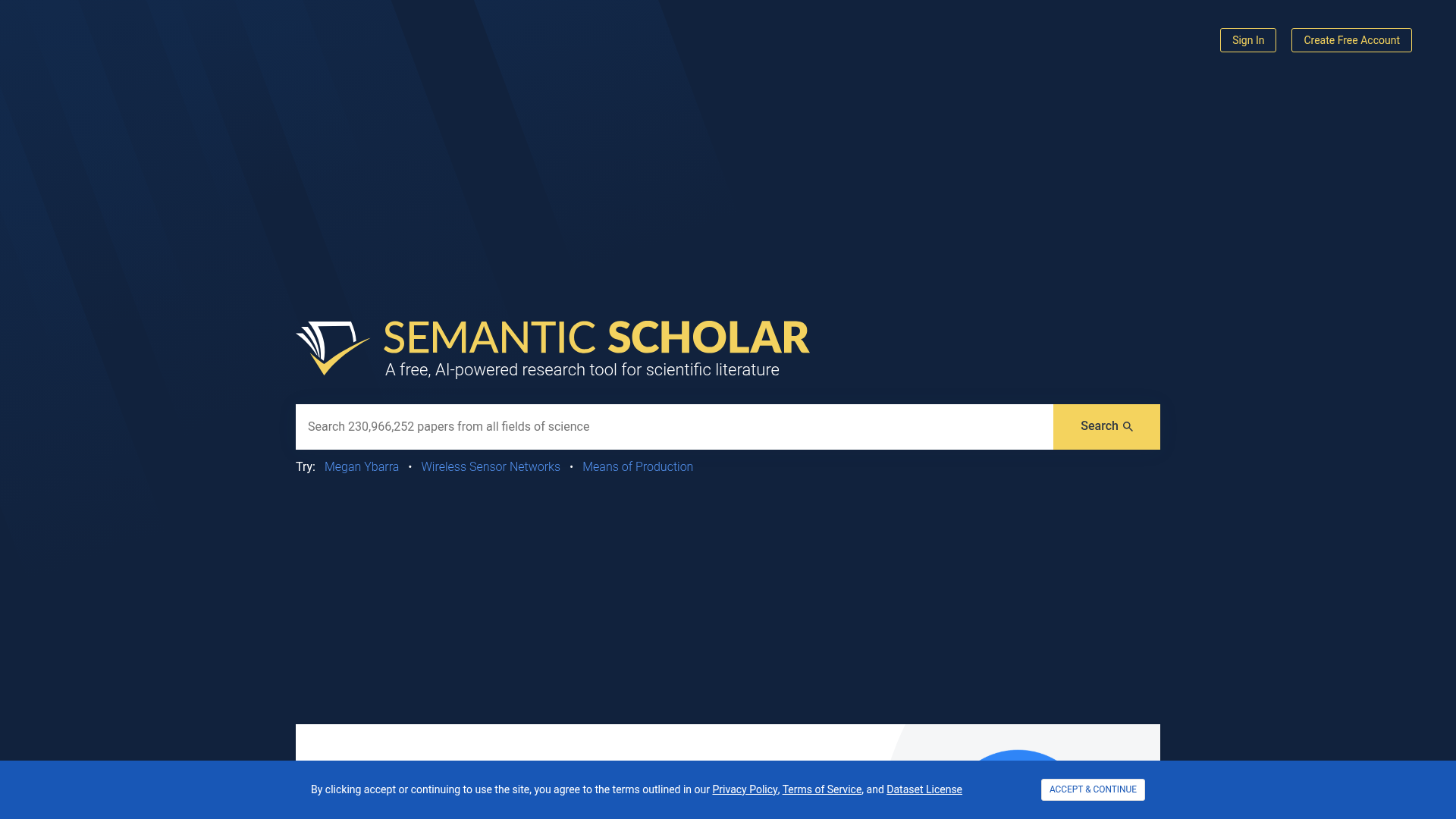
Explore Semantic Scholar's interface:
Frequently Asked Questions
Is Semantic Scholar free?
Yes. Semantic Scholar's search and discovery tools are free to use.
Who runs Semantic Scholar?
It is developed by Ai2, the Allen Institute for AI, a non-profit research institute. It launched in 2015.
How many papers does it index?
More than 214 million papers from all fields of science.
What is a TLDR?
An AI-generated, very short summary of a paper's main objective and results, shown in search results.
Does Semantic Scholar have an API?
Yes. The Semantic Scholar Academic Graph API provides data on papers, authors, citations and venues, and open datasets such as S2ORC are available.
Final Verdict
Semantic Scholar is the free baseline every researcher should know: a large corpus, TLDRs, feeds and alerts, all from a non-profit. It does not synthesize answers or run systematic reviews. Use it alongside a synthesis tool when you need more than search.